
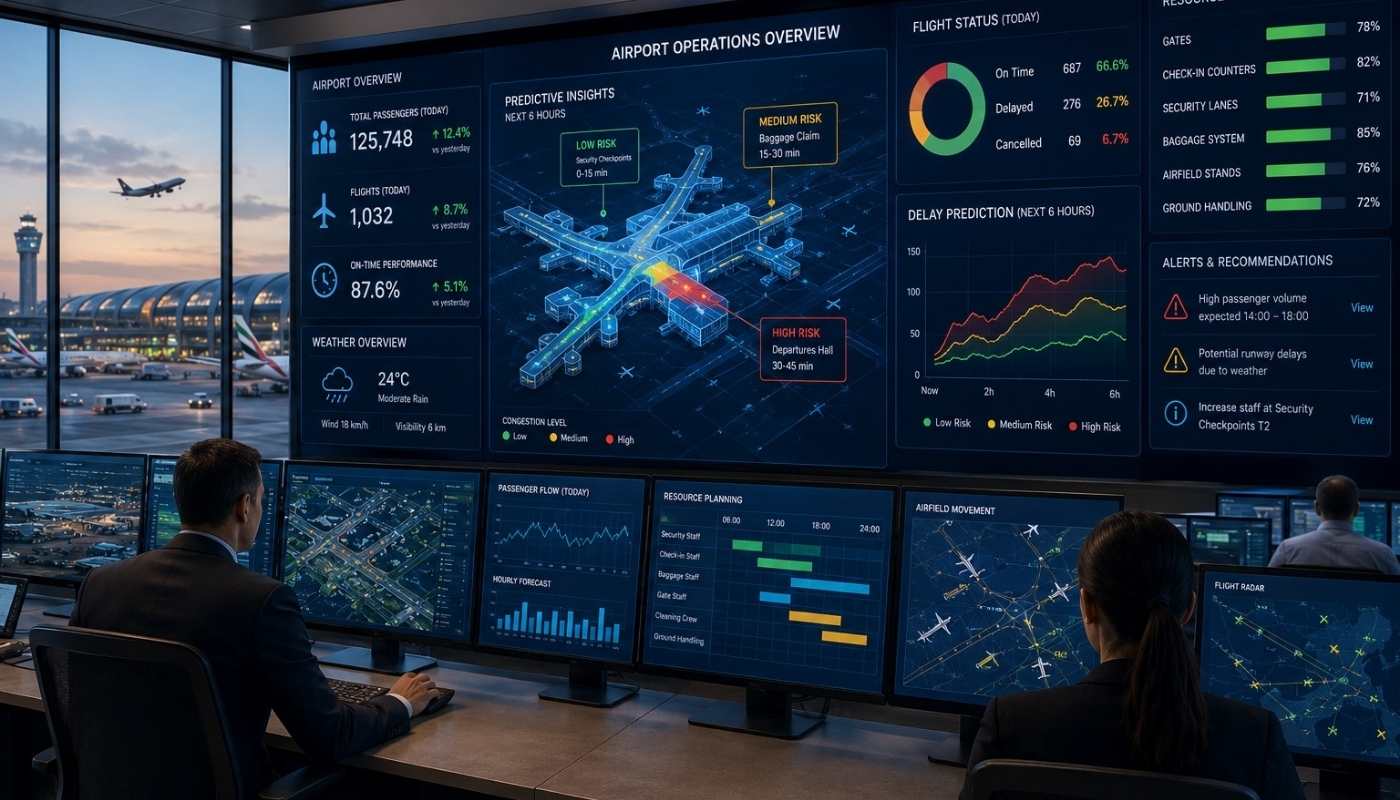
The aviation industry across the Middle East is entering a new phase of growth. Ambitious national aviation strategies, airport expansion programmes, rising tourism demand, and the emergence of new global aviation hubs are driving unprecedented increases in passenger volumes. Airports across the region are preparing to accommodate tens of millions of additional travellers annually, while airlines continue to expand fleets, routes, and services to meet growing demand.
However, with this growth comes increasing operational complexity. Managing peak travel periods, responding to disruptions, coordinating multiple stakeholders, and maintaining service quality have become significantly more challenging. Merely reacting to events as they occur is no longer a viable operating model in an environment that demands operational efficiency resilience and the effective management of are more important than ever.
The industry is now shifting towards a new operating model built around predictive, connected, and data-driven resilience. By combining real-time data sharing, artificial intelligence, integrated operations centres, and collaborative decision-making, airports and airlines are transforming how they anticipate challenges, optimise resources, and maintain seamless passenger journeys.
The Growing Challenge of Peak Demand
Few regions experience operational peaks on the scale seen across the Middle East. Seasonal travel surges, major international events, school holiday periods, and religious travel associated with Hajj and Umrah create significant fluctuations in passenger demand throughout the year. Specifically, this year saw over 1.5 million pilgrims from outside of Saudi Arabia arrive for Hajj, surprising 2025 figures.
For airport operators, these peaks affect every operational consideration. Passenger processing areas become more congested, baggage systems face higher loads, aircraft turnaround times become more critical, and staffing requirements can change dramatically within short periods.
Historically, operational responses have been reactive – deploy additional resources and personnel in the moment, manage disruptions after they occur, and then make up the delays over the following hours, days or even weeks. While this approach has served the industry for decades, it is becoming increasingly difficult to sustain as passenger numbers grow.
Anticipating demand, and its attendant potential for disruption, is the new marker of operational resilience and excellence.
Shifting to Predictive Operations
Until very recently, the majority of flight delays have been within the control of aviation stakeholders themselves. Analysts from with the US Department of Transport Statistics claim that between 2015-2025, around 30% of delays can be attributed to airline and airport operational inefficiencies (poor staffing, avoidable bottlenecks, etc. Another 30% were due to failures within the national aviation system, including outdated air traffic control (ATC) infrastructure, IT system failures, and staffing shortages. While this is the specific US aviation context, it highlights the inherent problems of relying on reactive operational strategies and decision making.
Rather than relying solely on historical data and manual decision-making, aviation organisations are increasingly using real-time information combined with predictive analytics to identify risks before they develop into operational disruptions.
Artificial intelligence and machine learning technologies are playing an important role in this transformation. By analysing vast amounts of operational data from flight schedules, weather systems, passenger flows, security checkpoints, baggage operations, and air traffic movements, predictive systems can identify emerging bottlenecks and recommend proactive interventions.
For example, predictive analytics can forecast passenger congestion within terminal areas several hours in advance, allowing airport operators to adjust staffing levels, open additional screening lanes, or reallocate resources before queues begin to form. Similarly, airlines can use predictive models to anticipate delays caused by weather patterns, airspace congestion, or aircraft rotations and implement mitigation strategies earlier in the operational cycle.
Backed by technologies that enable real-time and predictive data management, it’s possible for airports to get ahead of even the busiest periods and maintain smooth operating conditions.
Optimising Resources During Peak Periods
One of the most immediate benefits of predictive operations is improved resource optimisation. Airport resources are finite. Gates, stands, baggage systems, security checkpoints, ground handling equipment, and workforce availability must all be managed efficiently to support increasing passenger volumes.
Traditional planning methods often struggle to account for rapidly changing operational conditions. Predictive systems, however, can continuously analyse demand patterns and recommend adjustments in real time.
Workforce management platforms can forecast staffing requirements based on expected passenger flows and flight schedules. Gate management systems can optimise aircraft allocation to reduce congestion and improve turnaround performance. Baggage operations can anticipate processing peaks and adjust system capacity accordingly. Ground handling providers are also benefiting from greater operational visibility, enabling more effective deployment of personnel and equipment across the airfield.
The ability to optimise resources proactively not only improves operational performance but also reduces costs, enhances productivity, and supports more sustainable airport operations.
Enhancing the Passenger Experience
Operational resilience is no longer measured solely by on-time performance or capacity utilisation. Passenger experience is another area that has become a critical performance indicator for airports and airlines alike. Travellers increasingly expect accurate information, shorter waiting times, and seamless journeys regardless of operational circumstances. Meeting these expectations requires a more proactive approach to disruption management.
Predictive technologies are enabling airports and airlines to communicate with passengers earlier and more effectively when disruptions occur. Real-time notifications, dynamic wayfinding systems, personalised travel updates, and intelligent passenger flow management tools help reduce uncertainty and improve the overall travel experience.
When operational teams can anticipate delays, congestion, or resource constraints before they impact passengers, they are better positioned to implement mitigation measures that minimise disruption. This shift from reactive recovery to proactive management is becoming a defining characteristic of next-generation airport operations.
In the Spotlight: Hamad International Airport
As one of the region’s fastest-growing global hubs, Hamad International Airport offers a strong example of how Middle Eastern airports are moving towards this model of predictive and data-driven operational resilience.
As part of its wider smart airport programme, the airport launched an advanced Digital Twin initiative designed to provide a real-time operational view of the entire airport through a 3D interface. The platform integrates data from multiple airport systems and uses analytics and artificial intelligence to generate operational recommendations, helping teams make faster and more informed decisions.
The Digital Twin is used to manage aircraft stand conflicts, monitor critical airport assets, respond more effectively to operational alerts, and optimise the use of airport resources. By bringing together data from across the airport ecosystem, the platform supports proactive decision-making rather than reactive operational recovery.
Operational coordination is further supported through integrated control centre functions operated by Qatar Aviation Services. Its Operations Control Centre oversees more than 800 aircraft movements per day and uses real-time operational visibility to coordinate airside, landside, workforce, and equipment resources. This enables more intelligent allocation of manpower and assets during periods of operational pressure.
Ahead of the FIFA World Cup Qatar 2022, airport operator MATAR also implemented an AI-driven operational intelligence platform across both Hamad International Airport and Doha International Airport. Continually upgraded and refined, this system provides performance monitoring, airfield movement analysis, and operational insights – proving its worth in the World Cup year when the airport experienced a Year-on-Year increase of 101.9% in passenger numbers.
Together, these initiatives demonstrate how airports can combine real-time data, AI-powered analytics, integrated operations management, and collaborative decision-making to strengthen resilience. As passenger volumes continue to rise across the Middle East, Hamad International Airport provides a practical example of how predictive technologies can help airports stay ahead of disruption while maintaining operational continuity and passenger service standards.
Building a Connected Aviation Ecosystem
The future of aviation resilience will depend on the ability of stakeholders to operate as part of a connected ecosystem rather than as individual organisations.
Across the Middle East, governments, airports, airlines, and technology providers are investing heavily in digital transformation initiatives designed to create smarter, more integrated aviation networks. These investments align with broader national objectives focused on economic diversification, tourism growth, and global connectivity. As passenger volumes continue to rise and operational environments become more complex, the importance of predictive resilience will only increase.
The aviation industry is moving beyond traditional models centred on responding to disruptions after they occur. The next generation of airport operations will be defined by the ability to anticipate challenges, share information seamlessly, optimise resources dynamically, and maintain operational continuity under all conditions.
For airports and airlines across the region, resilience is no longer simply about recovering from disruption. It is about predicting it, preparing for it, and preventing it from impacting the passenger journey.
In an era of rapid aviation growth, predictive, connected, and data-driven operations are becoming the foundation upon which the future of airport excellence will be built.
